Mayowa Nwadike finds truth in his art and how it shaped his identity
The artist from Nigeria shared his artistic journey, upbringing and what inspires his pieces.
This article was originally published in New York Amsterdam News on May 15, 2025.
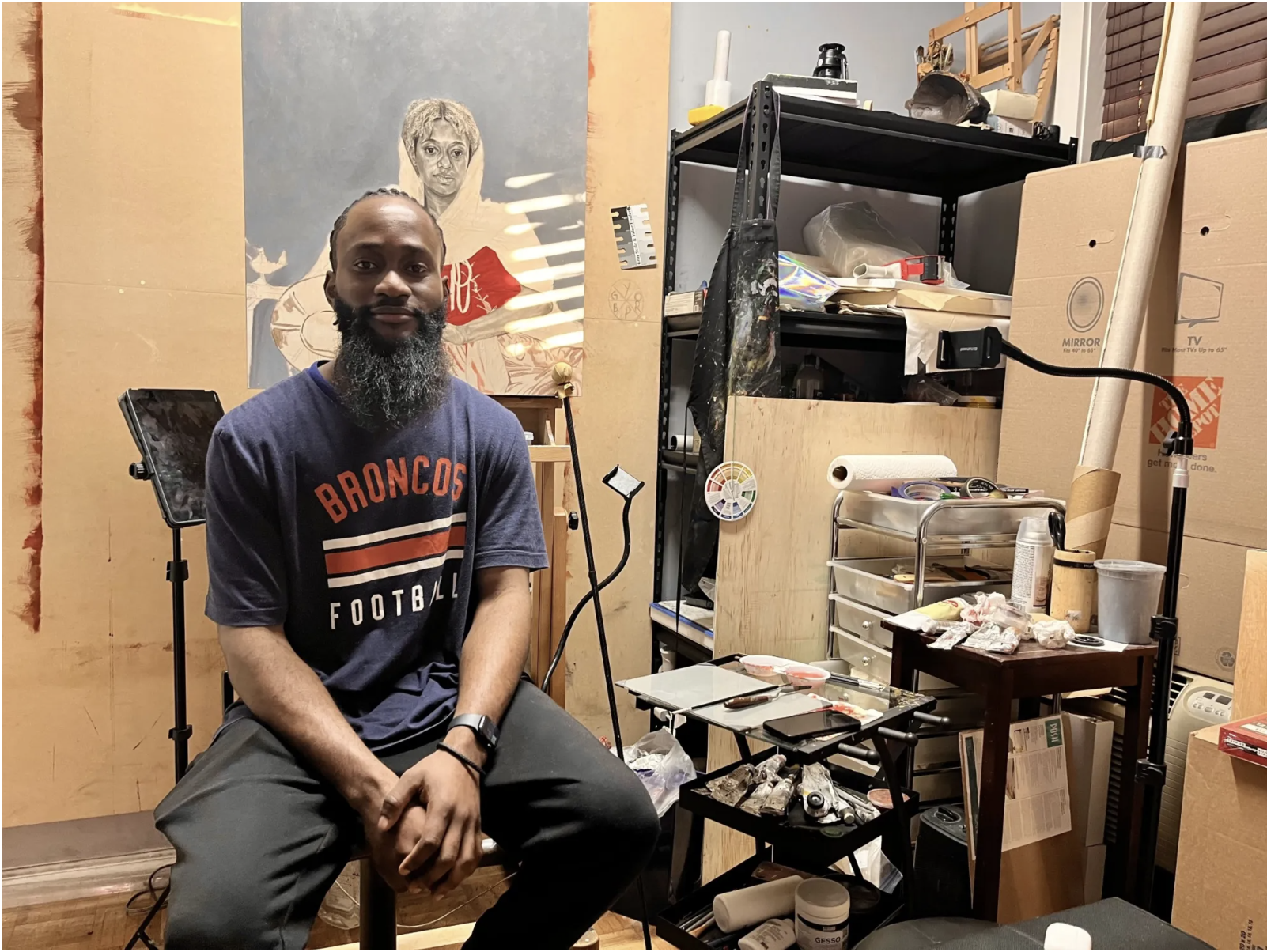
Mayowa Nwadike in his art studio. Photo/Gretchen Lembcke Peña
In 2021, two years away from graduating from the Federal University of Technology Akure in Gaga, Nigeria, Mayowa Nwadike was at a loss while sitting in his professor’s office for an advising session. After dedicating three academic years to his soil sciences degree, he wrestled with giving it up. He blurted out, “Professor, I want to drop out of school.” His professor asked why. Nwadike’s answer took him aback.
“I want to make art.”
That spur-of-the-minute admission kicked off Nwadike’s career as an artist. Since then, he has created paintings focusing on the immigrant experience, his struggle with toxic masculinity, and his African heritage. He has poured his hopes, fears, and thoughts into what he does — and the effects have rippled throughout the U.S. Nwadike’s work has been displayed in art museums and galleries, such as the African American Museum (Dallas), Whatcom Museum (Washington), Southampton African American Museum (New York), and many others.
Now 27, Nwadike lives in Harlem and has displayed his art in the Affordable Art Fair, where he put some of his pieces up for sale. This was his first experience exhibiting his art to be sold, and he was thrilled. “I feel like I spoke this into the universe, and it just happened,” he said. “I’m very proud about this.”
Nwadike had always been good at everything he did growing up. Linguistics, mathematics, sciences, sports, and everything in between seemed to come to him easily. Thanks to his heavily Christian family and community, he was never truly alone, but the social pressures weighed on him. The beliefs in Christianity alongside an absent father affected his view of the world. To keep up with the status quo, he became a STEM major when he entered university. However, he hid the biggest secret from his family: He loved doing art. Nwadike’s interest began when his art teacher in junior high said he should pursue it, which sparked something in him, but it didn’t come without its obstacles.
“My parents didn’t see the significance of me doing art,” Nwadike said. “It was something I couldn’t even do at home. They saw it as a waste of time. I got beat[en] for painting and drawing. I couldn’t do it at home because [they always told me], ‘Oh, go read your books!’”
Once he admitted to himself that he wanted to pursue art, though, his trajectory and even his routine changed: Wake up, go to class, do homework, paint until 4 a.m., sleep, repeat. All the while, he ran an interior design business, leaving him with no time to socialize while in university. It was all worth it, though, because he finally found something he loved doing. His childhood, religious beliefs, and past grappling with toxic masculinity found their way into every brush stroke and every line of charcoal he manipulated onto canvases, wood panels, and linen. People sent art commissions his way, including an overwhelming number from the United States. Feeling like it was a sign, he ultimately immigrated to America in 2021.
“I went home three days before [I had to leave] and told my mom, ‘I’m leaving,’” he said. “She was like, ‘No, you’re not. That’s crazy.’ I told her I wasn’t there to get her approval and that I went there to tell her.”
Nwadike arrived in New York City in August 2021 and began living on the Upper West Side with Ayodeji Otuyelu, an author, who had commissioned Nwadike’s art for his book. They became friends, and Nwadike had somewhere to stay as he found his way in not only a new country, but among new people, customs, and culture. Otuyelu witnessed his friend going through a hard time in his life while retaining so much passion and determination to achieve his goal: Create art.
“We went to an exhibition in Dallas,” Otuyelu recalled. “I remember the conversation we had. He was talking about how he wanted to work to evolve. How all he wants to do is make art, have his art shown everywhere around the world.”
The three months living in the United States proved difficult for Nwadike. He felt alienated from the rest of the world, with society’s perception of him being different from his home country’s.
“Before I said a word, it felt like I fit in. In appearance, you couldn’t tell I was from Africa,” he said. “The moment I said something, [though, people were like], ‘Oh, you have an accent,’ ‘Oh, where are you from?’ and they don’t look past that. Every other thing about me doesn’t matter.”
Eventually, he and Otuyelu moved to Harlem, allowing him to channel all that emotion into his art. After experiencing microaggressions, a language barrier, and a different lifestyle, his immigrant experience trickled onto the canvases. The effort he put into his work led him to be chosen for his work to be displayed at Gallery Petite in Brooklyn in 2022 for an art show. More than 400 people attended the event.
“It’s like hearing a child tell you what they want to be, and then you watch them become what they want to be,” said Otuyelu.
Since then, Nwadike has gone on to have various sales of his paintings and have coverage of his art. He has reconnected with his mother through the success of his work and has built his identity in his paintings. Most of all, he has realized the importance of art in today’s society.
“Being an artist or doing art or the true value of art lies within truth — the truth of the artist and the art,” he said. “If the art is true, then it is timeless.”