Latinos in New York: How They Voted in Tuesday’s Historic U.S Elections
The economy, migration, and public safety concern Hispanic voters.
By: Nicol León Arge, Ana María Betancourt Ovalle, María Fernanda Alarcón, Óscar Flores, Adelina Romero, Ilvea Lezama, Maggie Morett, Leyrian Colón Santiago, and Gretchen Lembcke Peña
This article was originally published on El Deadline on November 6th, 2024.
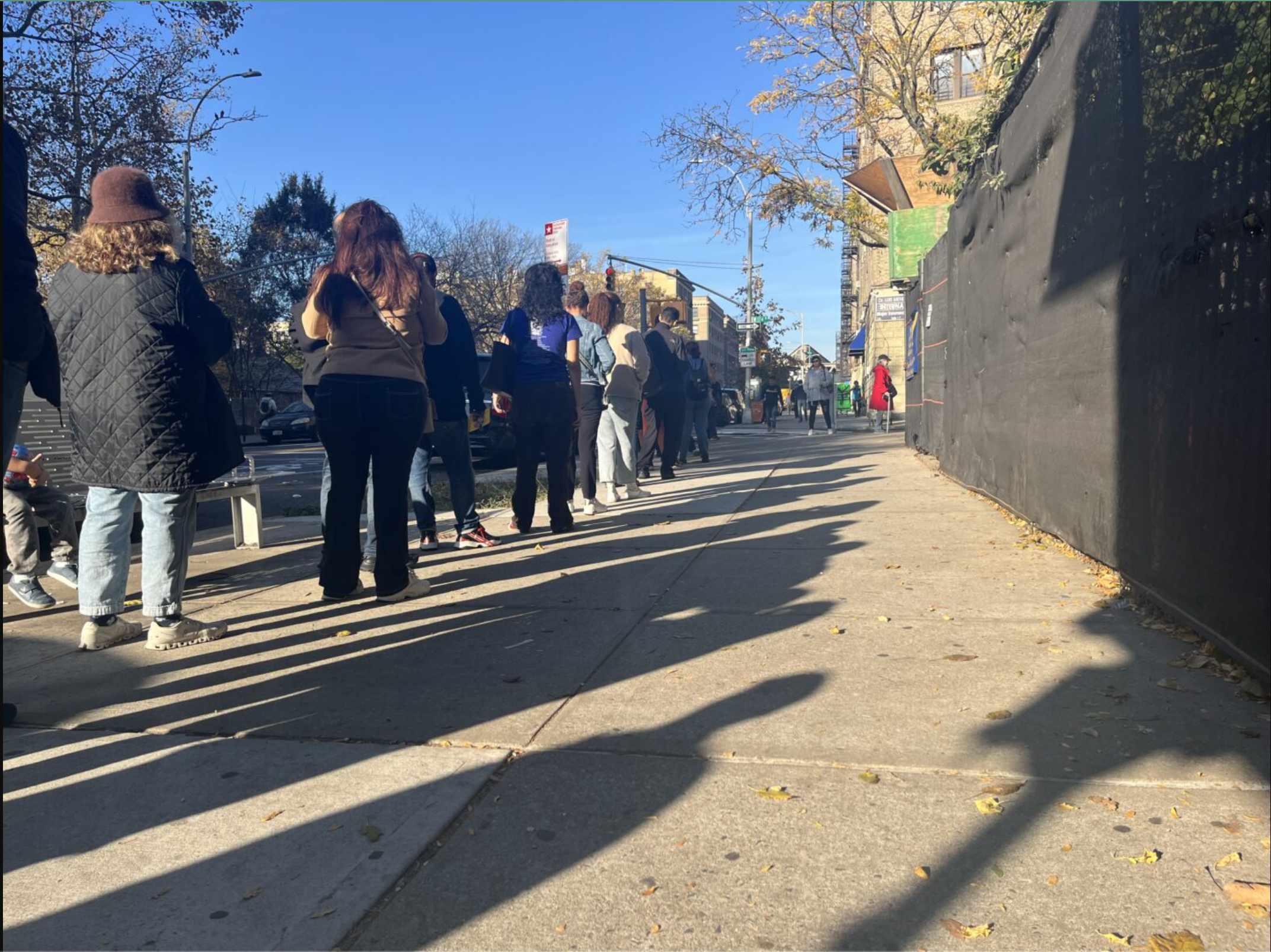
Voting line outside of P.S 173 in Washington Heigts. Credit: Gretchen Lembcke Peña
Outside schools and libraries in Mott Haven, Corona, and Elmhurst were Dominicans, Peruvians, Puerto Ricans, Ecuadorians, and people from many other Latin American countries. Some arrived in the United States decades ago and voted for the first time this Tuesday, November 5. Others have been voting for more than 40 years. They went to the polls to elect the next president of the United States and New York legislators.
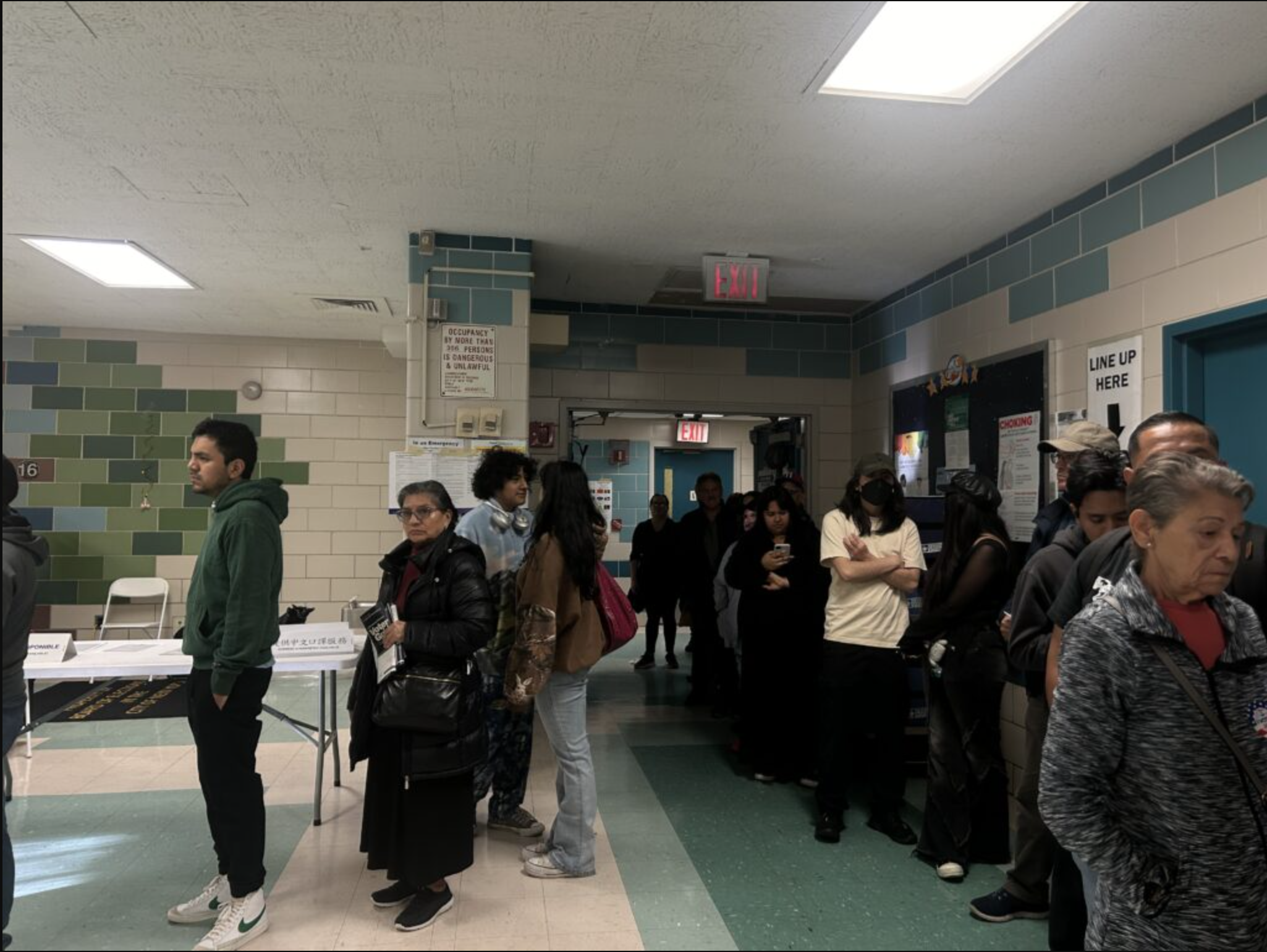
At P.S. 16 School in Corona, Queens, voters waited more than 40 minutes to cast their ballots. Credit: Leyrian Colón Santiago
Some voters leaned toward Democrat Kamala Harris in the hope that she would help the Latino community and protect women’s reproductive rights. Others preferred Republican Donald Trump because they believe he would improve the economy.
“I like to vote for a better future,” said María Peña, a Dominican national who emigrated to the United States in 1974. “It’s good for everyone to come out and vote to exercise their right — their right to express what they think and what they want.”
During Election Day on Tuesday, reporters from El Deadline visited polling places in New York neighborhoods with large Latino populations: Corona and Jackson Heights in Queens; Washington Heights in northern Manhattan; and Mott Haven in the South Bronx. Reporters spoke with voters about their motivations, their opinions of both presidential candidates, and the ballot initiatives or amendments presented by the state and local governments.
These New Yorkers are part of the 36.2 million Latinos in the United States who were eligible to vote in Tuesday’s general election — 4.4 million more than in the 2020 election — according to the Pew Research Center. Latinos are the second-largest group of eligible voters in the country.
Early Wednesday morning, Trump was declared the projected winner of the election, according to multiple projections, including the Associated Press. Harris received the most votes in New York City, with more than 1.6 million votes, according to preliminary results from the New York City Board of Elections.
In New York State, elections began on October 26 with early voting or mail-in ballots and concluded Tuesday at 9 p.m. In addition to choosing between former President Trump and vice-presidential candidate J.D. Vance or Vice President Harris and vice-presidential candidate Tim Walz, New York voters elected members of the U.S. Senate and House of Representatives. They also voted on whether to approve one amendment proposed by Governor Kathy Hochul and five proposed by Mayor Eric Adams.
In New York, known as a sanctuary city for Latino migrants (meaning it protects migrants from deportation or detention by immigration authorities), it was projected that 992,000 members of this community would cast ballots, according to a report by the National Association of Latino Elected and Appointed Officials (NALEO).
The Presidential Candidates’ Profiles Mobilized Latino Votes
Napoleón Méndez, a 65-year-old Dominican immigrant who arrived in the U.S. as a child, said he has voted at Juan Pablo Duarte School in Washington Heights for the past three decades. “I’ve always voted. (…) I’m very interested in politics,” Méndez said moments after voting, holding the traditional “I voted” sticker given out at polling sites.
“Of course I voted for Kamala [Harris], because change is needed and we have to give her a chance,” said Méndez, who works as a flight attendant. “Not just because she’s a woman, but because she’s capable. She’s qualified, and I think she can identify more with us — especially the middle class and the Latino community.”
Méndez said he hopes crime rates will decrease and that New York will become more orderly, and he expects whoever is elected president to help make that happen. “My biggest fear is that crime keeps increasing and that they won’t be able to control the situation,” he said.
Similarly, Harris’s profile as a woman from a working-class background inspired the vote of María Santos, a 69-year-old Dominican woman who lives in Washington Heights and has been a U.S. citizen for 31 years.
“Kamala [Harris] best represents the needs of the Latino community because she’s a humble woman who came from the bottom, very decent, and very educated. That’s why she should be president,” Santos said.
On Tuesday, Santos spent hours handing out flyers and holding signs in support of Harris outside the polling site at Juan Pablo Duarte Public School on West 183rd Street.
New York voters are overwhelmingly Democratic. In the past nine presidential elections, New Yorkers have voted for Democratic candidates. In 2016, 36.5% voted for Trump, while 59.01% voted for Hillary Clinton. The landscape changed little in 2020, when 37.7% voted for Trump and 60.9% voted for Joe Biden, according to CNN.
Juan Ramírez is part of the minority in New York City that votes Republican. Wearing a red cap and blue jacket, outside the polling place where he voted, he said he moved to the United States from the Dominican Republic 32 years ago. In his country of origin, he supports a right-wing party, the Social Christian Reformist Party.
He said he supports Trump’s candidacy because he agrees with his proposal to improve the country’s economy. “Trump fights hard for the economy of this country, and what we want is a president who will fix the economy, which is in bad shape,” Ramírez said.
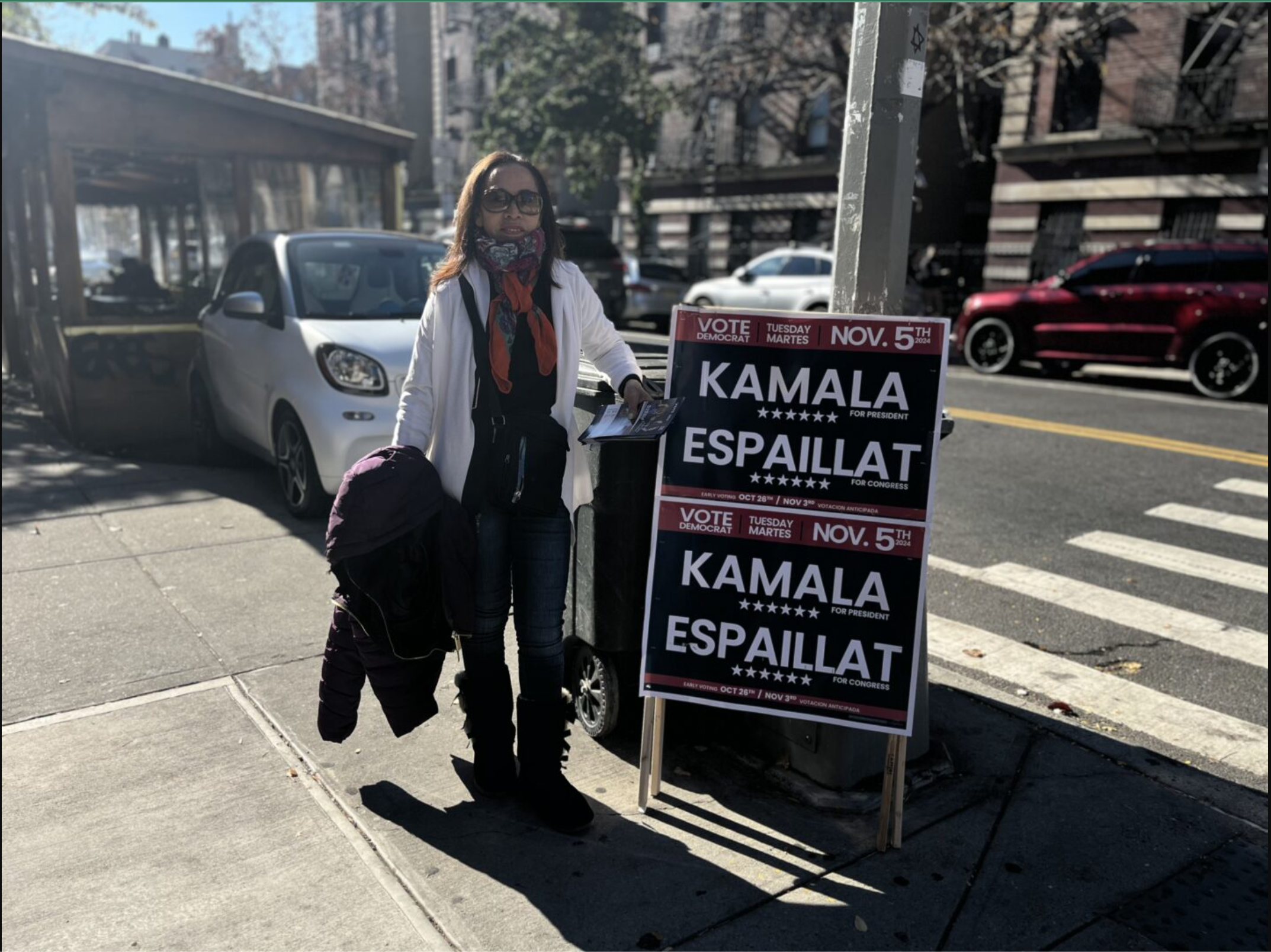
María Santos, a Dominican woman who has lived in the U.S. for 32 years, voted for Democratic candidate Kamala Harris because she identified with her story as a working woman. Credit: Gretchen Lembcke Peña
Anti-Immigrant Rhetoric
The arrival of more than 210,000 migrants to New York since 2022 has intensified anti-immigrant rhetoric, leading some voters to question the level of assistance the local government has provided to newcomers.
Republicans criticize government assistance, pointing to the $1.45 billion the city invested in aid for this population in 2023. However, migrants’ future economic contributions at the state level could be nearly double that amount. For example, according to an analysis by Documented, this population contributed $3 billion in taxes in New York State in 2021.
Trump has used the migration crisis as part of his campaign rhetoric. On Sunday, October 27, at a rally held at Madison Square Garden in New York, the candidate claimed without evidence that Harris “has imported criminal migrants from prisons and psychiatric institutions coming from Venezuela all the way to the Congo.”
During the same rally, comedian Tony Hinchcliffe made controversial jokes about migrants. “I welcome migrants to the United States with open arms. And by open arms, I mean like this,” he said while gesturing “no” with his hands. “These Latinos love making babies. They come inside, just like they did in this country.”
Hinchcliffe also referred to Puerto Rico as “a floating island of garbage.”
This narrative portraying migrants as invaders has resonated with some New Yorkers. Ana, a voter who lives in the South Bronx and did not want to give her last name, went to vote at Bronx Court accompanied by her two daughters, ages two and three.
“Newly arrived children are receiving a check every two weeks, and those of us who live here have to sacrifice,” she said. “Now they want to take away schools for children and all the benefits people have received, while parents keep paying taxes, but those who arrive aren’t required to do anything.”
There is no evidence that the New York City Department of Education has denied education to New York students in order to benefit newly arrived immigrant children.
According to the NYC Department of Education, no student can be asked about their immigration status to access school, making it impossible to prioritize students based on this factor. Department policy also states that education cannot be denied due to lack of space.
Other voters, such as 68-year-old Nelson Dones, support migrants.
“Everyone here is an immigrant. My parents came from Puerto Rico. New York has laws that protect against discrimination, and I hope it helps immigrants get papers and a pathway to legal status,” said Dones, who voted in Mott Haven.
Puerto Ricans and the Mock Vote
Puerto Ricans in New York can only choose to participate in one electoral contest: voting for the governor of Puerto Rico or for the president of the United States. Puerto Ricans living on the island cannot vote for president because Puerto Rico is a non-incorporated U.S. territory. Because of this, if Puerto Ricans in New York decide to participate in the Puerto Rican election, they can mail in their vote to select the island’s next governor along with a mock plebiscite in which citizens can choose their preferred presidential candidate.
According to social media posts, several Puerto Ricans crossed out both candidates’ faces with an “X” on the mock ballot and added phrases such as “Long live Puerto Rico and Free Palestine” and “genocidal.”
For Krystal Morales, a Puerto Rican resident of Washington Heights who mailed in her Puerto Rico ballot, it was a surprise to receive a ballot with Trump and Harris’s names.
“The presidential [mock] vote is a waste of time and paper. It’s like dangling something over our heads and mocking us because we can’t reach it,” Morales said. “What’s the point of knowing the people’s opinion if all those ballots end up in the trash?”
Morales described Harris as “the lesser evil.” “I agree with some of her domestic policies and align with her on more issues, which is why I symbolically voted for her,” she said. “However, both the Republican and Democratic parties are complicit in the genocide in Palestine, and I don’t truly support either American candidate.”
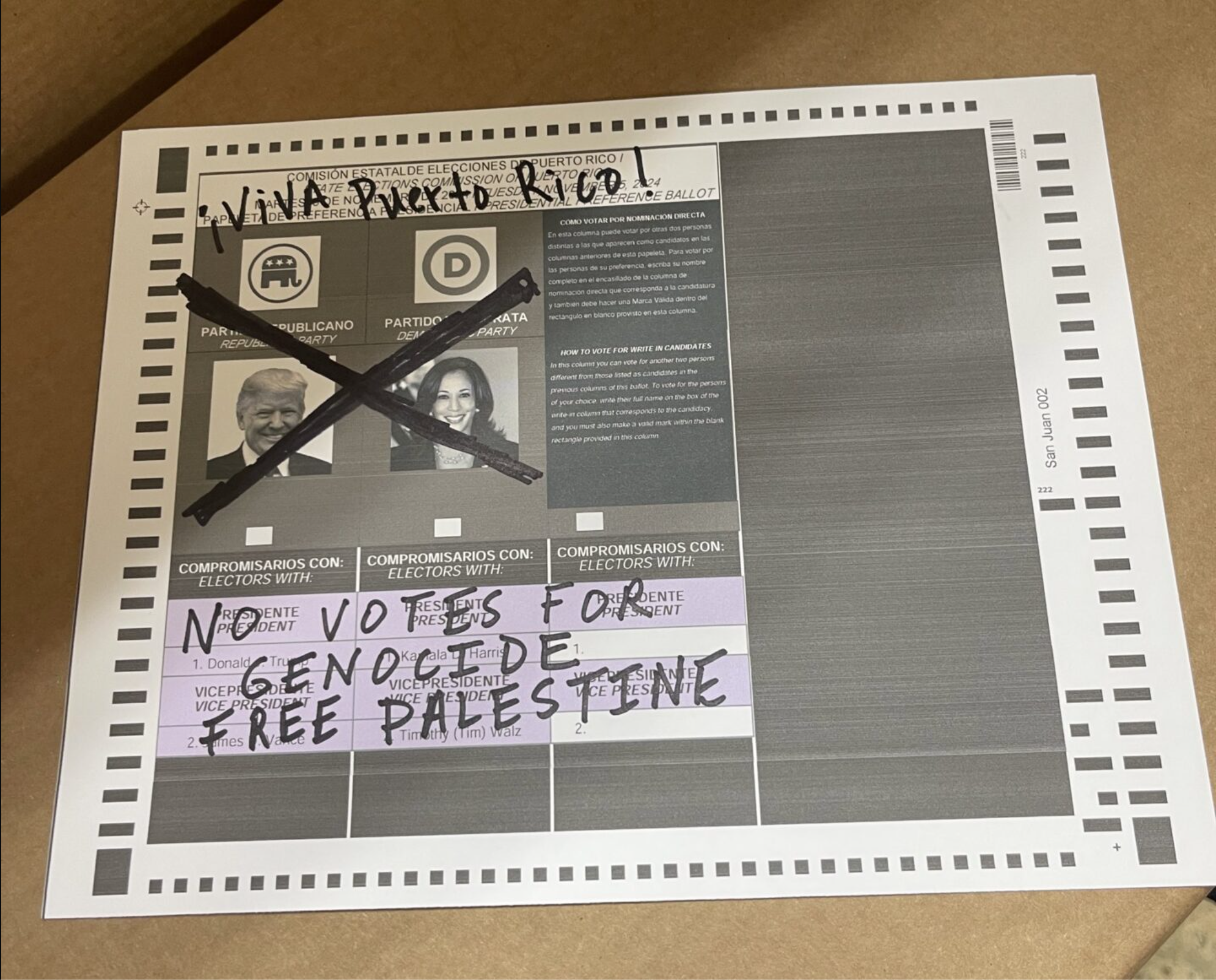
Image from Colectiva Feminista on X showing how some people voted in the Puerto Rican mock election.
Security Is a Top Priority
At the polling site operating at Public School 16 Nancy de Benedettis in Corona, Queens, voters began arriving at 6 a.m., before sunrise (which occurred at 6:34 a.m.). Expected election inspectors and translators did not arrive, causing lines to grow longer as the day progressed, explained an election worker who identified herself only as Ruth.
Guillermo Mergara Jr., a U.S.-born Latino who waited 45 minutes to vote, said the polling site needed more staff. “I think they should learn from past elections and have people who work faster,” said the 48-year-old.
Mergara said one of the issues he considered most when voting was the need for safer spaces in his community.
Alberto Castro, a 56-year-old Peruvian baker who has been a U.S. citizen for 23 years, has voted in every election with confidence in his choices. This time, he had doubts, but concerns about public safety ultimately influenced his decision.
“Since the border opened, a lot of undesirable people have come. This used to be a good, quiet neighborhood, but everything has gotten worse with the arrival of so many immigrants,” Castro said. “People tell me, ‘How can you oppose migrants if you were an immigrant?’ It’s not that I oppose it, but I’m afraid — there are many immigrants and not enough resources to support them.”
First-Time Voters
At a polling site on the corner of Roosevelt Avenue and 98th Street in Queens, Skyi Velasco, a 21-year-old Colombian-Ecuadorian student, voted for the first time.
“What motivated me to vote is that I want my voice and the voices of young people to be heard,” Velasco said. “There’s a lot of pressure on new generations, and there’s an atmosphere of fear.”
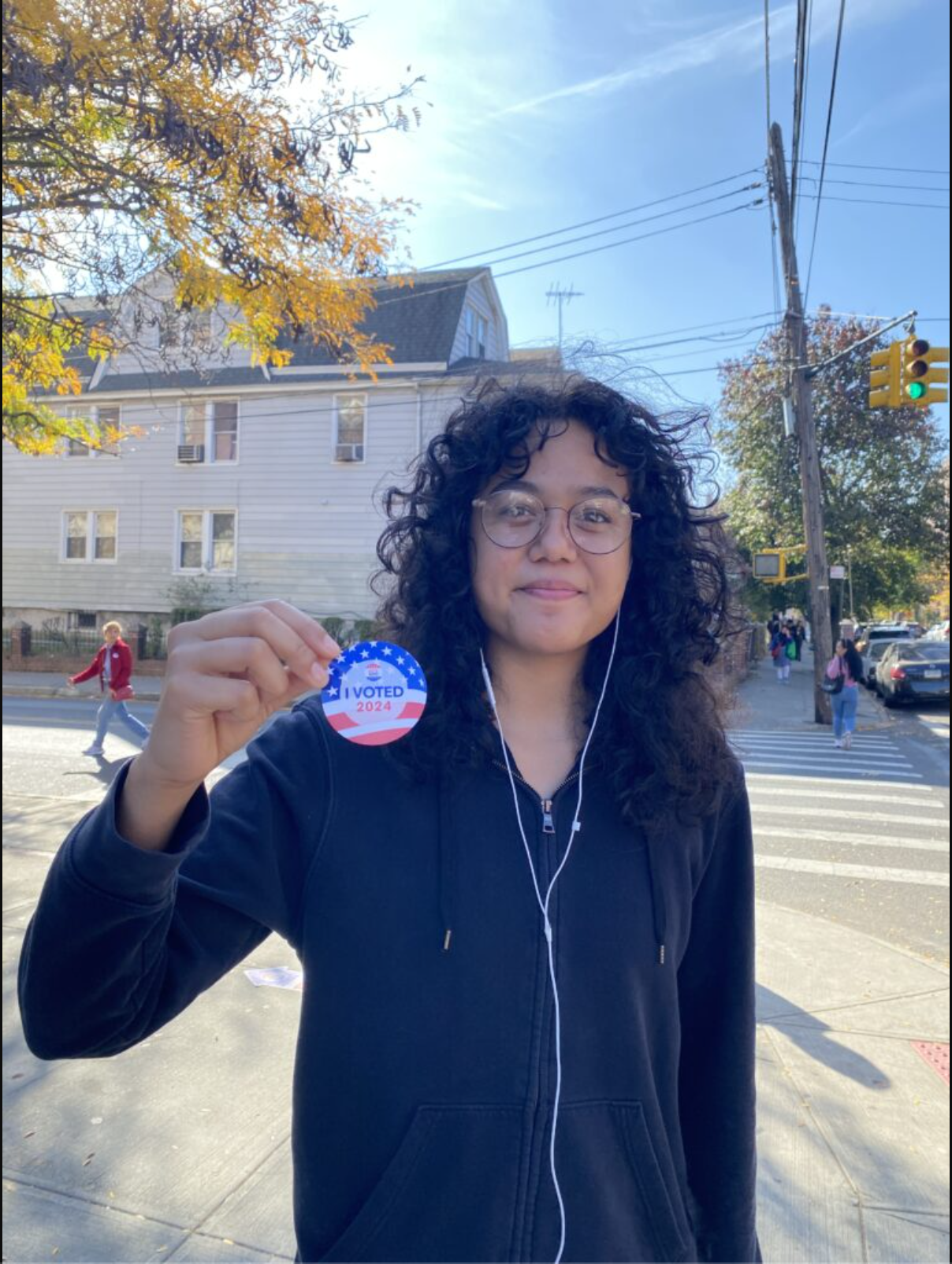
Skyi Velasco, 21, poses outside polling site P.S. 89 in Elmhurst, Queens, after voting for the first time. She said she voted in representation of her migrant parents who cannot vote. Credit: Ilvea Lezama
Others voting for the first time were newly naturalized U.S. citizens. Graciela Mochkofsky, an Argentine journalist who has lived in the United States for 11 years, voted for the first time in this election alongside her husband. (Mochkofsky is the dean of the Craig Newmark Graduate School of Journalism, which publishes El Deadline.)
“We weren’t originally going to become citizens, but during the Trump administration we saw a moment when Trump threatened to revoke citizenship from naturalized people,” Mochkofsky said. “We decided that if we wanted any influence and political rights, we had to become citizens.”
Another first-time voter was Alejandro Heredia, who emigrated from the Dominican Republic 30 years ago. He voted at Juan Pablo Duarte Public School 132 in Washington Heights, casting his ballot for Trump.
He said the Republican candidate’s proposals better meet the needs of Latinos who came to the U.S. without crossing the border and expressed hope that Trump would solve financial problems faced by retirees.
“The lowest pension among all developed countries is in the United States,” Heredia said.
What Else Did New Yorkers Vote On Tuesday, November 5?
In this election, Latino communities in New York also selected candidates for the U.S. House of Representatives and Senate; the New York State Senate; State Assembly; Supreme Court judges; Civil Court judges; and State Assembly members.
Currently, Republicans hold the majority in the U.S. House of Representatives, while Democrats hold more than half the seats in the Senate.
New Yorkers saw on their ballots the names of Class 1 Senate candidates, who began their terms in 2018 and were up for reelection in 2024. The U.S. Senate has three classes of senators; voters will elect Class 2 and Class 3 senators in 2026 and 2028, respectively. In this race, the winner was Democratic and Working Families Party candidate Kirsten E. Gillibrand.
For the U.S. House of Representatives, the winner was Democratic candidate Ritchie Torres. However, control of the House remains uncertain.
New Yorkers also voted for New York State senators. In that race, Democratic candidate Luis R. Sepúlveda defeated Republican candidate Bernadette E. Stroud.